
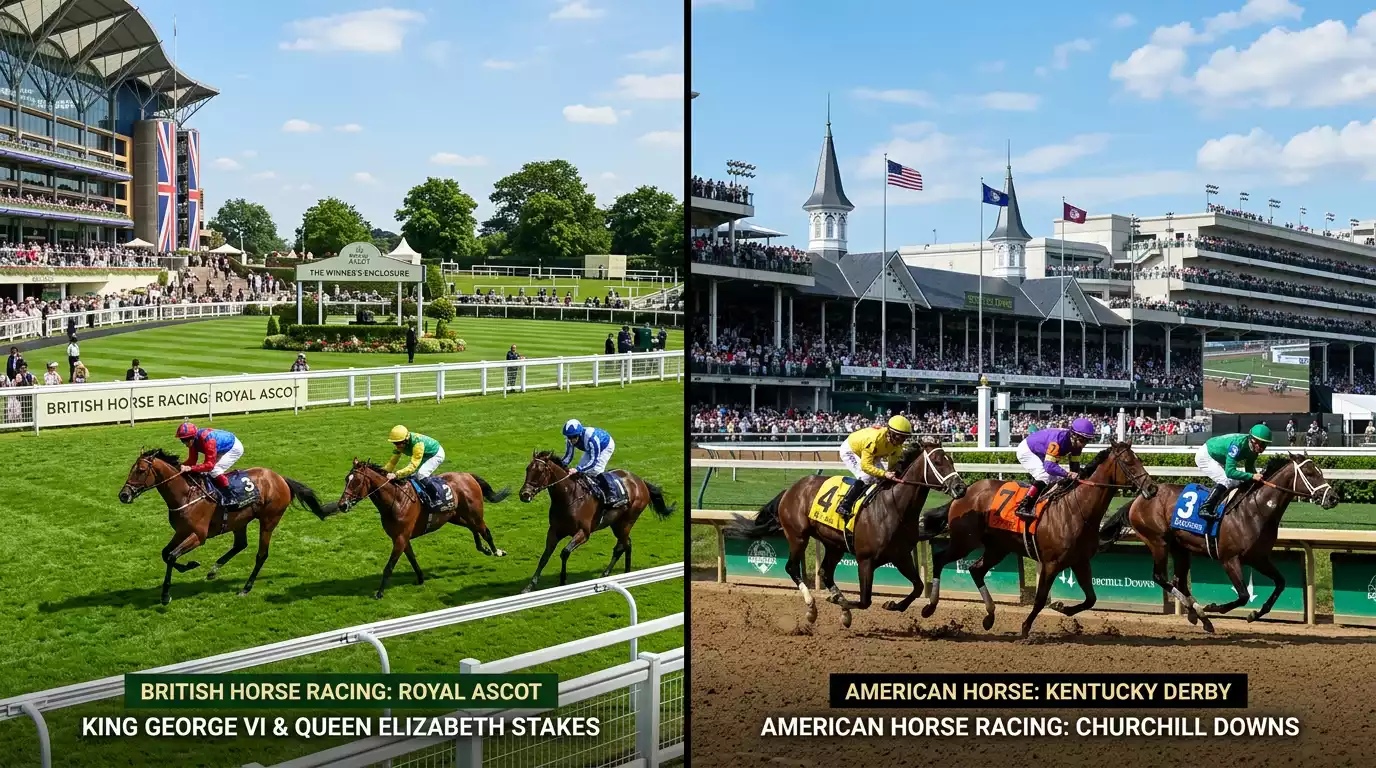
Visiting Santa Anita for the first time, I confidently asked for a “place bet” on a horse in the third race. The ticket seller looked confused. “Place means second only here,” she explained. “You want a show bet for third or better.” That exchange highlighted a fundamental truth: place betting terminology differs dramatically between British and American racing, and assumptions based on one system will cost you money in the other.
The European Commission, in their State Aid clearance decision for British racing, noted that UK racing and betting have a unique interdependency spanning over 200 years. That relationship developed distinct structures and terminology that diverge from American racing’s pari-mutuel traditions. Understanding both systems matters increasingly as international wagering becomes more accessible through online platforms.
What British punters call a “place bet” functions completely differently from what American horseplayers mean by the same words. Clarifying this distinction prevents expensive confusion.
The UK Place Bet System
In Britain, place betting operates within a bookmaker-dominated market offering fixed odds. When you back a horse to place, you’re betting it finishes in any of the paying positions – typically first, second, or third depending on field size and terms.
UK place terms vary by field size: two places for five to seven runners, three places for eight or more, and four places for handicaps with sixteen or more runners. The fraction applied to win odds – 1/4 or 1/5 – determines your place return relative to the win price.
The fixed-odds nature means you know your potential return before the race. Back a horse at 20/1 with 1/5 place terms, and a placing returns 4/1 plus your stake. That certainty contrasts fundamentally with pool-based systems where dividends depend on total wagering patterns.
Each-way betting bundles win and place into a single proposition, with half your stake on each component. This structure is distinctively British – American racing handles the equivalent bets separately rather than as a packaged product.
Bookmaker competition drives UK place terms into promotional territory that simply doesn’t exist in pari-mutuel environments. Enhanced places, BOG protection, extra places on major races – these features arise from commercial competition between fixed-odds operators seeking market share.
The US Win-Place-Show System
American racing operates primarily through pari-mutuel pools where all wagers of a given type are combined, the track takes its cut (typically 15-25%), and the remainder is divided among winning tickets. This creates fundamentally different dynamics than UK fixed-odds betting.
In US terminology, “place” means finishing second specifically – not second or third, just second. A place bet collects only if your horse finishes exactly second (or wins, which automatically qualifies). “Show” is the American equivalent of broader UK place betting – finishing third or better triggers a payout.
Returns depend entirely on how much money was bet into each pool, not on fixed odds. A heavily backed favourite might pay £2.20 on a £2 show bet, while an unconsidered longshot might pay £40 – the pool distribution, not pre-set odds, determines dividends.
This pool structure eliminates bookmaker margin in the traditional sense, replacing it with track takeout. But it also eliminates the certainty of knowing your return before the race. American bettors accept this uncertainty as inherent to the system; British bettors often find it disorienting.
Late money has pronounced effects in pari-mutuel pools. Heavy wagering on one horse in the final minutes before post time can dramatically reduce that horse’s dividend while improving payouts on others. This dynamic creates both opportunity and frustration – sharp bettors time their wagers to avoid being crushed by late favourite support.
Exotic wagers – exactas, trifectas, superfectas – dominate American racing betting culture more than in Britain, partly because the pari-mutuel system makes these complex multi-horse propositions relatively straightforward to process. UK betting culture evolved differently, with bookmaker each-way betting serving similar appetite for complex outcomes.
Key Differences Summarised
The terminology confusion is the first barrier. UK “place” encompasses American “place” and “show” combined. When a British punter backs a horse to place, they’re accepting finishes from first through second or third. When an American backs a horse to place, they’re targeting second specifically.
Odds certainty differs fundamentally. UK bettors know exactly what a place finish will pay before the race runs. American bettors know only after all wagering closes and pools are calculated – a return that might exceed or disappoint expectations based on late money patterns.
Promotional competition doesn’t exist in American pari-mutuel markets the way it does with UK bookmakers. No American track offers “extra places” or “best odds guaranteed” because the pool structure doesn’t permit such innovations. The track’s takeout is fixed; the remaining pool is divided by formula.
Betting mechanics diverge too. UK each-way betting creates a packaged win/place proposition with a single transaction. American bettors who want equivalent exposure must place separate win, place, and show bets – or use an “across the board” wager that explicitly combines all three.
International online betting increasingly allows UK bettors to wager on American racing and vice versa. When doing so, understanding which system governs your bet prevents nasty surprises. The same horse, the same finishing position, might be a winning bet under one system and a loser under the other.
Currency conversion adds another layer when betting internationally. Returns denominated in dollars need conversion to pounds, with exchange rates affecting your actual profit. Factor this into value assessments when the arithmetic suggests borderline opportunities – currency drag can turn marginal value into no value.
FAQ
Navigating Both Systems Successfully
If you’re betting internationally, clarity on which system applies to each wager prevents costly errors. The same words mean different things; the same finishing position triggers different outcomes; the same expectations lead to different realities.
For British punters exploring American racing, embrace the pool structure’s uncertainty while appreciating its transparency – you’re competing against other bettors, not against bookmaker traders. For American horseplayers trying UK betting, enjoy the price certainty while recognising that bookmaker margins replace pool takeout as the house edge.
The Triple Crown races – Kentucky Derby, Preakness, Belmont – attract significant UK interest and offer opportunities to apply cross-system knowledge. Major UK bookmakers price these events with fixed odds, letting British bettors engage with American racing using familiar mechanics rather than navigating unfamiliar pool betting.
Understanding UK place betting mechanics in full depth starts with our comprehensive each-way betting guide, covering the terms and calculations that define British racing wagering.
Articles
Written by the editors at placebethorseracinguk.com.
