

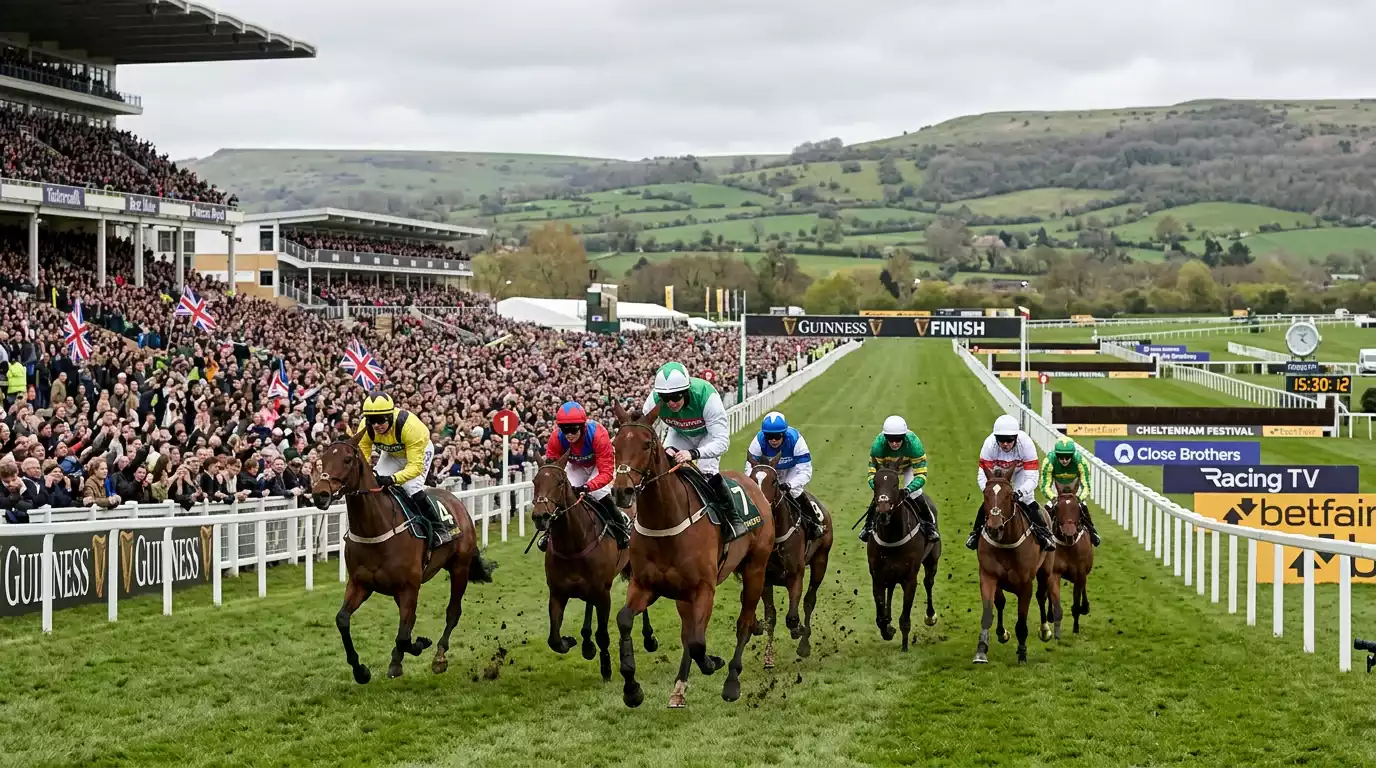
The roar from the Cheltenham crowd hit me through the television speakers as I watched my 16/1 selection finish fourth in the County Hurdle. Four places paid. Return secured. The friend beside me? Same race, same finishing position, different bookmaker – three places. His face said everything. At Cheltenham, where you bet matters almost as much as what you bet.
The Festival generates betting activity that dwarfs almost any other meeting in the racing calendar. Each-way wagers at Cheltenham surged 25% in 2024 alone, driven partly by punters recognising the value that enhanced place terms can offer in competitive fields. With peak TV audiences reaching 1.8 million for feature races – the highest in four years – the commercial pressure on bookmakers to offer attractive terms has never been greater.
What makes Cheltenham particularly interesting for place betting is the variety. You’ll find everything from small-field Grade 1 contests with just five or six runners to cavalry-charge handicaps approaching 30 horses. Each race type demands different thinking, different terms awareness, and different approach to finding value.
Cheltenham Handicap Place Terms
The big Festival handicaps are where place betting comes alive. Take the Coral Cup, County Hurdle, or Martin Pipe – these typically attract fields of 20+ runners, triggering enhanced place terms that can stretch to four, five, or even six places depending on your bookmaker and any promotional offers in play.
Standard terms for Cheltenham handicaps with 16 or more runners are four places at 1/5 the odds. That’s your baseline. But I’ve tracked bookmaker behaviour across multiple Festivals, and promotional extensions to five or six places are common, particularly for the highest-profile handicaps on Gold Cup day and Champion Hurdle day.
The arithmetic here rewards careful selection. In a 24-runner handicap paying four places, you’re looking at roughly a 17% chance of any given runner finishing in the money purely by probability. Extend that to five places, and you’re at about 21%. These aren’t enormous differences, but across a Festival of 28 races with substantial each-way action, they compound into meaningful edge.
Field sizes at Cheltenham handicaps have remained robust compared to everyday racing. While almost 28% of British races in spring 2025 had six or fewer runners – the second-highest proportion in two decades – the Festival’s prize money and prestige ensures competitive fields. This is precisely where place betting thrives: large, competitive races where multiple horses have genuine chances.
I pay particular attention to the conditional jockey handicaps and the less glamorous contests on the undercard. These often fly under the radar for casual punters but can offer excellent each-way value when field sizes push into the 20s and promotional place terms extend beyond standard levels.
Cheltenham Championship Race Place Terms
Grade 1 races at Cheltenham present a completely different picture. The Champion Hurdle, Queen Mother Champion Chase, Stayers’ Hurdle, and Gold Cup itself typically attract fields of eight to twelve runners. These aren’t place betting paradises.
Standard terms for these smaller fields are two or three places at 1/4 the odds. With eight to eleven runners, you’ll see three places paid. Drop below eight, and it’s two places at 1/4. The fraction change from 1/5 to 1/4 matters more than many bettors realise – it represents a 25% difference in your place returns relative to the win odds.
Does this mean championship races are poor each-way propositions? Not necessarily, but your approach needs adjustment. In a tight market with a dominant favourite, the place portion of an each-way bet on a 6/1 third-choice might offer genuine value if you believe two or three horses will fight out the finish. The bookmaker’s place market often overestimates the favourite’s chances of filling a place position.
The Festival’s championship events drew massive attention in 2025, with bookmakers reportedly paying out over £50 million in Best Odds Guaranteed enhancements across the four days. That figure reflects both the volume of betting and the frequency with which early prices were beaten by starting prices – something that happens regularly when ante-post markets contract approaching race day.
For championship races specifically, I tend to approach place betting as insurance rather than primary strategy. Back a horse to win because you think it’ll win; the each-way element simply protects against a narrow defeat. Contrast this with handicaps, where the place portion can be the main profit driver.
Enhanced Places at the Festival
Bookmaker competition at Cheltenham reaches fever pitch. The commercial importance of the Festival means operators extend place terms as a customer acquisition and retention tool. Understanding how to access and evaluate these offers separates informed punters from the crowd.
Enhanced place promotions typically appear in two forms: blanket extensions covering all Festival races, and race-specific offers targeting the biggest handicaps. The blanket approach is convenient but often modest – perhaps one extra place across all qualifying races. Race-specific offers tend to be more aggressive, sometimes adding two or three places on headline contests.
Simon Clare, PR Director at a major operator, noted that racing needs its equine stars to resonate with sport bettors. Horses like Constitution Hill and Galopin Des Champs have become household names in the Jump racing scene, and their Festival appearances drive betting volumes that justify generous promotional terms. When a genuine superstar runs, expect enhanced offers.
Timing your Festival bets requires balancing price deterioration against promotional clarity. Most operators confirm their full place terms seven to ten days before the Festival. Earlier prices might offer value, but you’re betting blind on exactly what terms will apply. My personal approach: lock in genuinely attractive ante-post prices with operators who historically offer competitive terms, then use race-week money with whichever bookmaker confirms the best specific terms.
One tactical consideration often overlooked – some enhanced place offers exclude Best Odds Guaranteed. You’re choosing between potentially better odds at starting price or more places paid at your early price. Neither is universally correct; the right choice depends on the specific horse, market dynamics, and how much you value the insurance of extra places versus the potential upside of BOG.
FAQ
Your Cheltenham Place Betting Edge
The Festival concentrates more place betting value into four days than most punters encounter in a year of racing. Those enhanced terms on 24-runner handicaps, the promotional competition between operators, the sheer volume of competitive races – it all creates an environment where understanding place mechanics delivers real advantage.
My Festival preparation always includes mapping out which races fall into which place-term categories before a single bet is placed. Championship races get one approach, handicaps another. The homework happens in the weeks before, so race-day decisions become execution rather than calculation.
For a detailed breakdown of how field size determines your place terms across all racing, explore our complete guide to place terms by number of runners.
Articles
Written by the editors at placebethorseracinguk.com.
