

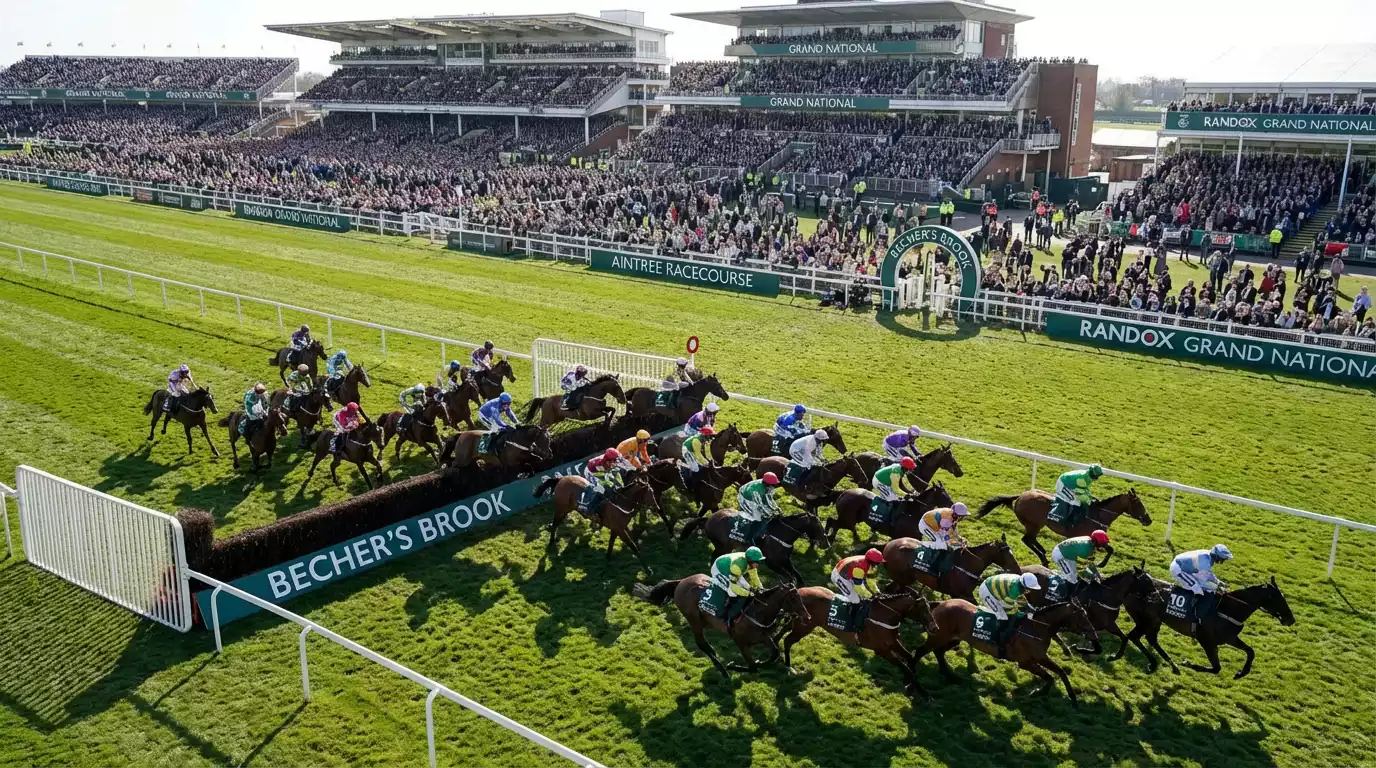
I remember my first Grand National bet vividly – backing a 40/1 outsider who finished fourth, only to discover I’d placed my each-way wager with a bookmaker paying just four places. The horse behind mine? Fifth, and his backers got nothing. That single experience taught me something critical: at Aintree, understanding place terms isn’t just helpful – it’s the difference between celebration and regret.
The Grand National stands apart from every other race in the British calendar. With approximately 40 runners charging over those famous fences, the betting turnover reaches staggering heights – around £250 million changes hands on this single race each year. What makes this particularly interesting for place bettors is how bookmakers respond to that massive field. Standard races with 16 or more runners typically pay four places at 1/5 the odds, but the National operates under enhanced terms that can stretch to six or even seven places depending on your bookmaker.
Here’s a statistic that shaped my approach to National betting: roughly 50% of all Grand National wagers come from stakes of £5 or less. These aren’t hardened punters – they’re once-a-year bettors looking for value and excitement. If you’re among them, or even if you’ve been betting on racing for decades, getting your head around the specific place terms for this unique race can transform a near-miss into a payout.
Grand National Place Betting Rules
The standard place terms you’ll encounter for the Grand National typically look like this: six places paid at 1/5 the odds. But I’ve learned never to assume – bookmakers compete fiercely for National betting business, and terms can vary significantly between operators.
Why six places rather than the standard four for a 16+ runner handicap? The answer lies in field size and commercial reality. With around 40 runners going to post, four places would mean roughly 10% of the field finishing in the money. At six places, that proportion increases to about 15%, which feels more generous to punters but still represents reasonable value for bookmakers given the each-way margins they build into their odds.
The 1/5 fraction is standard for large-field handicaps, and the National is no exception. What this means in practice: if you back a horse at 20/1 each way, and it finishes in the places but doesn’t win, you’ll receive 4/1 (one-fifth of 20/1) for the place portion of your bet. Your win portion loses, naturally, but the place part delivers a return.
I should mention the confusion that catches out newcomers every April. The Grand National generates approximately 700% more betting activity than even the Cheltenham Gold Cup. That surge in casual bettors means bookmaker customer service lines get flooded with questions about why someone’s fifth-placed horse didn’t pay out when they assumed “place” meant top five. The reality is that your specific bookmaker’s terms determine everything – not some universal racing rule.
One technical point that matters: the number of runners at the off determines your place terms, not the number of declared runners earlier in the week. Late withdrawals can occasionally reduce the field below 40, though the National almost always runs with a full complement. If, hypothetically, significant withdrawals dropped the field to 15 runners, standard bookmaker rules would apply – and you’d be looking at just three places paid.
Historical Place Terms at Aintree
The evolution of Grand National place terms tells a story about how competitive the betting market has become. Twenty years ago, five places was considered generous. Now, six is standard and seven isn’t unusual during promotional periods.
This generosity didn’t emerge from bookmaker kindness – it came from market pressure. When one major operator extended their place terms, competitors followed within hours. The result is a race to the top that benefits punters, though it’s worth remembering that these enhanced terms get factored into the odds themselves. Nothing comes free in betting.
The race itself has seen structural changes that affect place betting considerations. The field size has fluctuated over the decades, occasionally dipping below 40 due to safety concerns or entry patterns. The modifications to fences introduced in the 2010s didn’t directly change place terms, but they did affect completion rates – more horses now finish the race, which theoretically reduces the value of each individual place.
I find the National’s place betting history reflects broader industry trends. The betting market generates significant revenue that flows back into racing through the levy system – the Horserace Betting Levy Board collected £108.9 million in 2024/25, the highest since the 2017 reforms. Big races like the National contribute disproportionately to these figures, which partly explains why bookmakers are willing to offer enhanced terms. The race brings in customers who might not bet on racing at any other time of year.
Looking at the specifics of recent years, place terms have stabilised at six places as the baseline, with the 1/5 fraction remaining constant. Some years have seen individual bookmakers push to seven places for promotional reasons, particularly in the run-up to the race when competition for each-way business reaches its peak.
Extra Places on the Grand National
A punter messaged me last year asking whether extra place offers on the National were “too good to be true.” My response: they’re good, but they’re not charity.
Extra place promotions for the Grand National typically extend the standard six places to seven, sometimes eight. The mechanics are straightforward – your horse finishes in the extended place positions, and you receive a payout at the stated fraction. What these promotions don’t change is the fraction itself. You’ll still get 1/5 the odds for your place return.
The value calculation here requires honest assessment. Adding a seventh place on a 40-runner race increases your chances of a place payout from roughly 15% to about 17.5%. That’s meaningful, but it’s not transformative. Where extra places become genuinely valuable is in each-way accumulators – that additional 2.5% compounds across multiple legs, creating substantially better each-way value over the course of a Saturday’s betting.
Timing matters with these promotions. Bookmakers typically announce their Grand National place terms several weeks before the race, giving you time to plan your approach. Some operators offer price guarantees alongside extra places, protecting your early-price selection against SP drifters while still paying out on the enhanced terms. These combined offers represent the sharpest value, assuming you’ve identified horses likely to drift.
I’ve noticed around 30% of Grand National bettors are first-timers or returning after a significant break from betting. For this group, extra place offers provide a genuine cushion against the race’s notorious unpredictability. When you’re backing 25/1 and 33/1 shots – as most casual National punters do – every additional paying position improves your experience.
The catch with extra places, and there’s always a catch, lies in odds adjustment. Bookmakers aren’t offering something for nothing. Enhanced place terms often coincide with slightly tighter odds across the board. The arithmetic usually works out in the punter’s favour, but not by as much as the headline “seven places!” suggests.
FAQ
Making the Most of Grand National Place Terms
After nine years of analysing place betting mathematics, I’ve developed a simple pre-National routine. First, I check the confirmed field size – anything above 35 runners typically triggers standard enhanced terms. Second, I compare place terms across at least five bookmakers, focusing on both the number of places and any additional promotions like Best Odds Guaranteed. Third, I consider each-way value specifically, not just win odds. A horse at 33/1 with one bookmaker offering six places might represent worse value than the same horse at 28/1 with another offering seven.
The National rewards patient, informed betting more than any other race on the calendar. Its unique combination of a massive field, unpredictable obstacles, and enhanced place terms creates opportunities that simply don’t exist in standard racing. Whether you’re staking £5 for fun or approaching the race with serious intent, understanding exactly what you’re betting into – and what terms will determine your returns – puts you ahead of the crowd.
For those wanting to build on these foundations, understanding the broader framework of place terms by runner numbers will help you spot value not just at Aintree, but across the entire racing calendar.
Articles
Published by the placebethorseracinguk.com team.
