

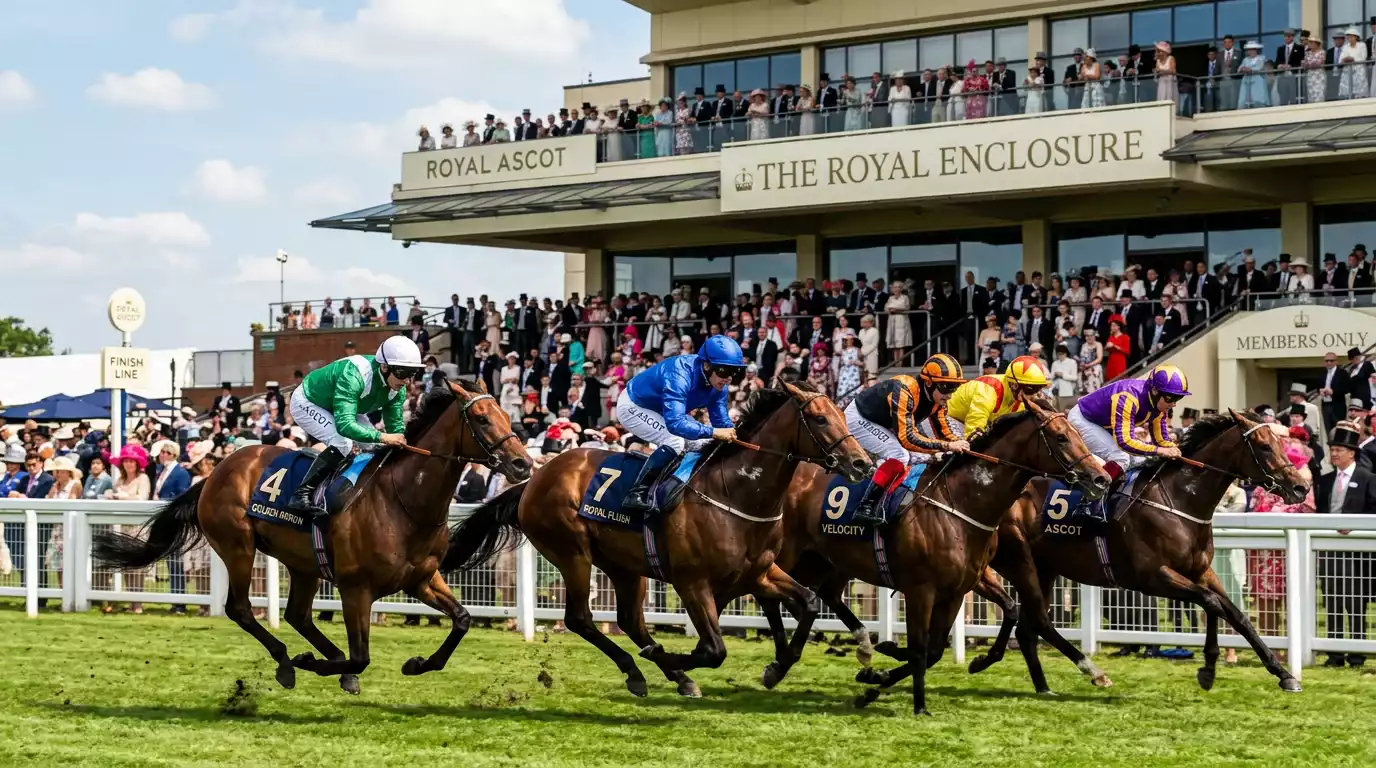
Standing in the betting ring at Royal Ascot, I overheard a conversation that perfectly captured the meeting’s place betting complexity. Two punters argued over whether the Royal Hunt Cup paid four or five places – one was right, one was wrong, and neither bothered to check before staking. That casual approach costs real money at Britain’s premier Flat meeting.
Royal Ascot delivers the most diverse place betting landscape of any UK fixture. Five days, thirty races, everything from elite Group 1 contests with half a dozen runners to heritage handicaps with fields pushing towards thirty. The average field size at Premier Flat fixtures hit 11.02 runners recently, up from 10.86 – and Ascot’s flagship meeting pulls those numbers higher still with prize money that attracts maximum entries.
What makes Ascot particularly rewarding for place bettors is the contrast between race types scheduled back-to-back. You might analyse a seven-runner Commonwealth Cup paying two places at 1/4 the odds, then immediately pivot to a 28-runner Royal Hunt Cup offering four or five places at 1/5. The mental gear-change catches out punters who don’t adjust their strategy between races.
Royal Ascot Handicap Place Terms
The cavalry-charge handicaps are Royal Ascot’s place betting crown jewels. The Royal Hunt Cup, Wokingham Stakes, and Buckingham Palace Stakes regularly attract fields exceeding 25 runners, triggering enhanced terms that transform each-way betting economics.
Standard terms for these behemoths are four places at 1/5 the odds – but standard rarely applies at Ascot. Bookmaker competition drives promotional extensions to five, sometimes six places on the biggest handicaps. I’ve seen the Hunt Cup paying six places with major operators, effectively giving you a 21% probability of hitting a paying position before you even consider form, draw, or ground.
Field composition matters as much as field size. A 24-runner handicap where three horses dominate the betting isn’t the same proposition as one where the market spreads evenly across the field. The latter offers superior place betting value because more horses have genuine each-way chances. At Ascot, the quality depth typically ensures competitive markets rather than top-heavy betting rings.
Draw bias adds another dimension specific to Ascot’s straight course. Certain conditions favour high or low draws disproportionately, which affects place probability more than win probability. A horse drawn poorly might have minimal winning chance but could still hit the frame if it finds racing room – that’s pure place betting territory.
I track historic place finishes by draw position across different going conditions, building a picture of which stalls offer each-way value even when win chances are compromised. This granular work isn’t glamorous, but it identifies consistent edges that pure form study misses.
Royal Ascot Group Race Place Terms
The pattern races at Ascot present a stark contrast. The Gold Cup, Queen Anne Stakes, and Prince of Wales’s Stakes attract elite but limited fields – typically six to ten runners competing at the highest level.
Place terms shrink accordingly: three places at 1/4 odds for fields of eight to eleven, two places for seven runners or fewer. That shift from 1/5 to 1/4 means your place return on a 10/1 shot drops from 2/1 to 2.5/1 equivalent – still meaningful, but the mathematics change significantly.
Group race place betting becomes about identifying which horses are locked on for frame finishes. In a Gold Cup with seven runners, two places paid, your each-way selection needs to beat five rivals rather than finding a spot in a crowded handicap. The question shifts from “can this horse hit the frame?” to “can this horse beat most of the field?”
Market structure in Group races often creates place value that isn’t immediately obvious. When a dominant favourite is sent off at 4/6, bookmakers sometimes price the each-way market generously for second favourites. The assumption is that the favourite will win, so place odds reflect competition for minor positions only. If you believe the favourite is vulnerable, that place market mispricing becomes an opportunity.
The Duke of Cambridge Stakes, Coronation Stakes, and similar contests with maximum fields of ten to twelve occupy a middle ground – three places paid, competitive enough for each-way thinking but not the value-rich environment of the handicaps. These races reward selective engagement rather than systematic each-way approaches.
Finding Value at the Royal Meeting
Total UK racecourse attendance reached 5.031 million in 2025 – the first time exceeding five million since 2019 – and Royal Ascot contributes disproportionately to that figure. The crowds create atmosphere, but they also create betting patterns that informed punters can exploit.
The casual money that flows into Ascot’s betting pools tends to concentrate on fashionable selections, often over-backing horses with high profiles or attractive stories. This leaves place value on unfashionable contenders – exposed handicappers, returning absentees, trainers outside the spotlight. Each-way value frequently lies in the 16/1 to 33/1 range where frame finishes are realistic but public support is limited.
Bookmaker promotions reach their zenith at Royal Ascot. Enhanced places, BOG guarantees, and money-back specials proliferate across all five days. The smart approach involves mapping promotions to specific races before the meeting begins. Which operator offers six places on the Hunt Cup? Who extends places on the Wokingham? This intelligence determines where each bet should be placed.
Early pricing at Ascot rewards preparation. Ante-post markets open weeks before the meeting, allowing position-taking on likely big-field runners before promotional terms are confirmed. The risk is betting before knowing exact place terms; the reward is securing prices that compress dramatically as the meeting approaches.
One underappreciated angle: the Friday and Saturday handicaps often offer superior place terms to identical-quality races earlier in the week. Bookmakers front-load their promotional ammunition for the meeting’s finale, saving the most generous terms for when customer attention peaks.
FAQ
Positioning Your Ascot Place Bets
Nine years of analysing Flat racing mathematics has taught me that Royal Ascot concentrates place betting opportunities more intensely than any other meeting. The convergence of large fields, quality depth, competitive bookmaker promotions, and diverse race types creates value that simply doesn’t exist at routine fixtures.
Preparation is everything. Know which races fall into which place-term categories. Identify the promotional landscape before the first race. Build your staking plan around the specific mathematics of each handicap rather than applying blanket each-way strategy across the meeting.
For the framework underlying all place term decisions, see our comprehensive guide to place terms by number of runners – the principles apply whether you’re betting at Ascot or your local evening meeting.
Articles
Published by the placebethorseracinguk.com team.
