

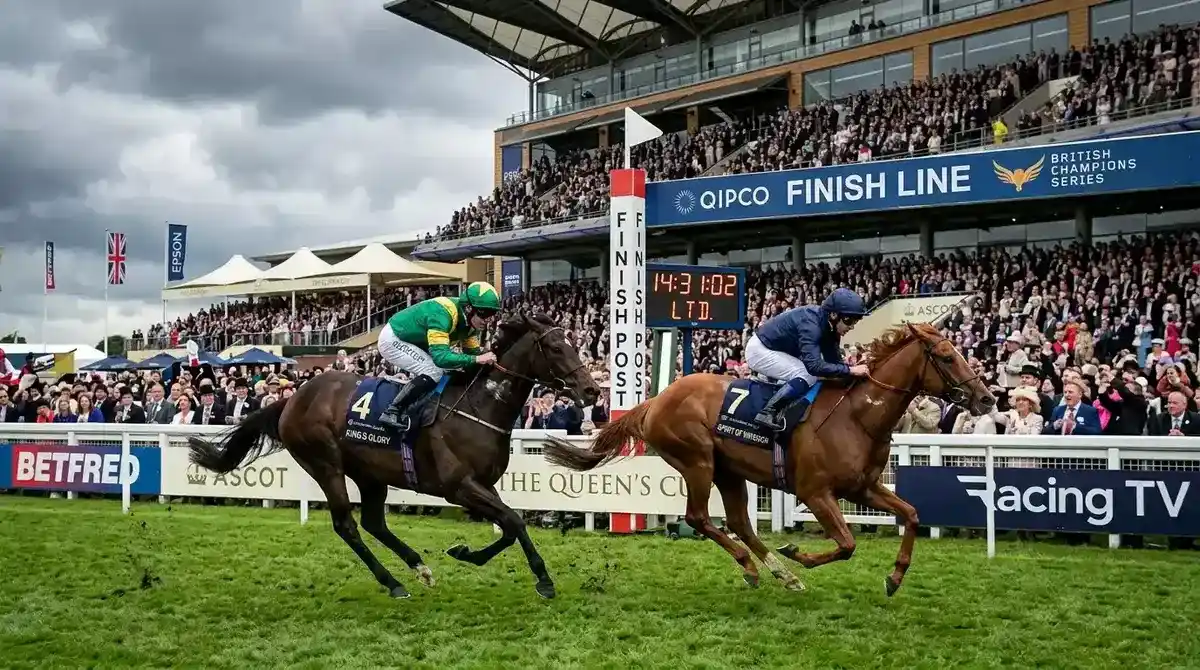
I remember the first time each-way betting truly clicked for me. A friend had backed a 14/1 shot that finished second in a competitive handicap, and instead of walking away with nothing, he collected a decent return. That moment changed how I approached horse racing. Each-way betting explained in simple terms is this: you are placing two bets in one, giving yourself a second chance to profit even when your horse does not win.
The numbers tell the story of how popular this approach has become. Each-way wagers at the Cheltenham Festival surged by 25% in 2024, reflecting a broader shift in how punters manage risk. After nine years of analysing place betting mathematics, I have watched this two-part wager evolve from a casual punter’s safety net into a sophisticated tool that serious bettors use to extract value from the markets.
What makes each-way betting so appealing is the insurance element. You are not simply hoping for the best outcome — you are building in protection against the frustrating near-miss. But this protection comes at a cost, and understanding when that cost is justified separates profitable bettors from those who slowly bleed their bankroll. Throughout this guide, I will break down exactly how each-way betting works, when it offers genuine value, and when you are better off taking a different approach.
What Is an Each-Way Bet?
A punter once asked me why his £10 each-way bet cost him £20. That single question reveals the most important thing to understand about each-way betting: it is not one bet, but two separate bets bundled together.
The first part of your each-way bet is a win bet. This works exactly like any other bet on a horse to win the race. If your selection crosses the line first, this portion pays out at the full advertised odds.
The second part is a place bet. This pays out if your horse finishes in one of the designated paying positions — typically second or third, depending on the number of runners. The place portion pays at a fraction of the win odds, usually either one-quarter or one-fifth.
Here is how the stake breakdown works in practice. When you place a £10 each-way bet, you are actually staking £10 on the win and £10 on the place. Your total outlay is £20. This is why each-way betting is sometimes called “win and place” betting — because that is literally what you are doing.
Three possible outcomes exist with each-way betting. First, your horse wins the race. In this scenario, both parts of your bet are successful. The win bet pays at full odds, and the place bet also pays because a winner has by definition “placed.” Second, your horse finishes in a paying place position but does not win. Here, you lose the win portion of your bet but collect on the place portion. Third, your horse finishes outside the places or fails to complete the race. In this case, you lose both parts of your bet.
The beauty of each-way betting lies in that middle scenario. Without the place component, a second-place finish would return nothing. With each-way, you still walk away with something. Whether that something represents good value depends entirely on the odds and the place terms — factors I will examine throughout this guide.
One common misconception is that each-way betting is only for cautious punters. I have found the opposite to be true in certain situations. On big outsiders in competitive fields, the place portion of an each-way bet can actually represent better value than the win portion. Understanding this dynamic is key to using each-way betting effectively.
Each-Way Place Terms by Field Size
The single biggest mistake I see punters make with each-way betting is not checking the place terms before they bet. These terms determine how many positions pay out and at what fraction of the odds — and they vary significantly depending on the size of the field.
Standard UK place terms follow a straightforward structure tied to runner numbers. In races with 5 to 7 runners, bookmakers typically pay two places at one-quarter of the win odds. Once a race has 8 or more runners, this extends to three places, but the fraction drops to one-fifth of the odds. For handicap races with 16 or more runners, four places are paid, still at one-fifth odds.
These thresholds matter enormously for value assessment. The average field size in Flat racing sits at 8.90 runners, meaning most Flat races fall into the three-place category with 1/5 odds. Jump racing averages 7.84 runners per race, which places more National Hunt races in the two-place bracket with the more generous 1/4 fraction.
Let me illustrate why this matters with a concrete example. You back a horse at 10/1 each-way in a seven-runner race. The place terms are 1/4 odds for two places. If your horse finishes second, you collect at 10/4, which equals 2.5/1. Now imagine the same horse in a nine-runner race. The place terms drop to 1/5 odds for three places. Your second-place finish now pays at 10/5, which equals 2/1. That is a 20% reduction in place returns for what might seem like a minor change in field size.
The picture becomes more complex when you consider the trade-off. Yes, the nine-runner race pays at lower odds, but it also pays one more position. Your horse now has three chances to place rather than two. Whether this compensates for the reduced fraction depends on the competitive nature of the race and your assessment of where your selection will finish.
I always check field size before placing any each-way bet. A race sitting right on a threshold — say, eight runners where one might be withdrawn — can swing between two different sets of terms. Being caught out by this is an unnecessary way to lose value.
Some bookmakers offer enhanced place terms as promotional incentives. You might see “four places on all ITV races” or “1/4 odds on handicaps” during festival periods. These promotions can shift the value equation significantly, making each-way betting more attractive on races where standard terms would not justify the approach.
How to Calculate Each-Way Returns
Standing in a betting shop queue, fumbling with mental arithmetic while others wait impatiently — I have been there more times than I care to admit. Learning to calculate each-way returns quickly transformed my pre-race decision making and helped me identify value bets that others overlook.
The fundamental formula for each-way returns depends on your outcome. For a winning horse, you collect on both portions: the win bet pays at full odds, and the place bet pays at the fractional odds. For a placed horse that does not win, you collect only the place portion. The total always includes your returned stake on the successful bet or bets.
Let me walk through the complete calculation method. Suppose you place £5 each-way on a horse at 8/1 in a 10-runner race. Your total stake is £10 (£5 win, £5 place). The place terms are 1/5 the odds for three places, making your place odds 8/5.
For the win calculation: £5 at 8/1 returns £5 multiplied by 8, plus your £5 stake back. That equals £45. For the place calculation: £5 at 8/5 returns £5 multiplied by 1.6, plus your £5 stake back. That equals £13. If your horse wins, you collect both amounts: £45 plus £13 equals £58. Your profit is £58 minus your £10 total stake, which gives you £48.
If your horse finishes second or third but does not win, you lose the £5 win stake but collect the £13 place return. Your profit is £13 minus your £10 total stake, which equals £3.
Understanding these mechanics reveals something important about each-way value. The place portion of the bet in this example offers odds of 8/5, or 1.6/1. If you genuinely believe the horse has a better than 38% chance of finishing in the top three, the place bet alone represents value. This is why I sometimes focus purely on the place component when analysing potential each-way bets.
Scenario 1: Your Horse Wins
The dream outcome for any each-way bet is watching your horse cross the line first. When this happens, the mathematics work beautifully in your favour.
Consider a £10 each-way bet at 12/1 in a race with 1/4 place terms. Your total stake is £20. The win portion returns £10 multiplied by 12, plus the £10 stake — that is £130. The place portion pays at 12/4, which equals 3/1. This returns £10 multiplied by 3, plus the £10 stake — another £40. Your total return is £170, representing a £150 profit on your £20 outlay.
Compare this to a straight win bet. A £20 win-only bet at 12/1 would return £260, giving you a £240 profit. The each-way approach sacrifices £90 of potential profit for the security of place coverage. Whether this trade-off makes sense depends entirely on your confidence in the selection winning versus placing.
I have a rule of thumb that guides my thinking here. If I am backing a horse because I genuinely believe it will win and the odds accurately reflect its chances, I lean towards win-only. If I am backing it because I think it is overpriced relative to its placing chances — perhaps a consistent performer in a competitive field — each-way often makes more sense.
The place portion on a winner is essentially bonus money. You would have collected on the place anyway, so the fractional odds become pure upside. This is why each-way betting rewards patience in selection. Finding horses that win at prices is the goal, and the place insurance softens the blow when they finish close but not close enough.
Scenario 2: Your Horse Places Only
The near-miss. Your horse battles through the final furlong, finishes a gallant second, and you feel that mix of frustration and relief. This is where each-way betting earns its keep.
Let me use the same £10 each-way example at 12/1 with 1/4 place terms. Your horse finishes second. The win portion is lost — that £10 is gone. The place portion, however, pays at 12/4 or 3/1. You receive £10 multiplied by 3, plus your £10 stake back, totalling £40. After deducting your £20 total stake, you walk away with a £20 profit.
Without the each-way component, that second-place finish returns nothing. The £20 you would have staked on a win-only bet would be entirely lost. This is the psychological appeal of each-way betting and its genuine financial benefit in races where your selection is competitive but facing stiff opposition.
The value question becomes crucial here. In the scenario above, the place portion alone returned 2/1 on your £10 place stake. If you assessed your horse as having a 40% chance of placing, that bet had positive expected value regardless of the win outcome. I often find myself running these place-only calculations before deciding on each-way, because the place component needs to justify itself independently.
One pattern I have noticed over years of tracking results: horses that consistently place but rarely win can generate steady returns through each-way betting. These are often exposed handicappers, reliable types who finish in the frame without having the acceleration to win. Identifying such horses, particularly at longer prices, has been a profitable niche in my own betting approach.
Each-Way vs Place-Only Betting
A question that crops up repeatedly in my conversations with fellow bettors: if you are really just interested in the place, why not bet place-only and skip the win portion entirely?
Traditional bookmakers in the UK do not offer place-only bets as a standalone product. Each-way is bundled, meaning you must take both the win and place portions together. This is a deliberate design that benefits the bookmaker’s margins, because many punters would prefer to bet purely on place outcomes at certain prices.
Betting exchanges changed this dynamic. On platforms operating peer-to-peer markets, you can back a horse to place without the win component. The place markets on exchanges function independently, with their own odds determined by supply and demand rather than a fraction of the win price.
This creates interesting opportunities. Exchange place odds sometimes offer better value than the fractional place terms from traditional bookmakers. Other times, the bookmaker each-way route comes out ahead. Comparing both options before placing a bet has become standard practice in my approach.
The cost comparison is straightforward. With each-way, you stake double — £10 each-way costs £20. Half of that outlay is riding on the win, which you might view as a lower-probability outcome. With exchange place-only, you stake only on the outcome you actually want. If you would have bet £10 each-way, you could instead put £20 directly on the place at exchange odds. The question becomes whether the exchange place odds justify the concentrated exposure.
My experience suggests exchange place markets offer particular value in high-profile races where liquidity is strong and odds are competitive. In smaller races with thinner markets, the spreads can erode any theoretical advantage. The Tote also offers place pools, though the pari-mutuel nature means you do not know your exact odds until the race is complete.
For most recreational bettors, each-way remains the simpler and more accessible option. The major bookmakers all offer it, the terms are standardised, and there is no need to navigate exchange interfaces or manage liquidity concerns. The trade-off for this convenience is accepting the bundled structure rather than optimising each component separately.
Finding Value in Each-Way Markets
The day I stopped thinking about each-way bets as a single unit and started analysing win and place components separately was transformative for my results. Value in each-way markets hides in places most bettors never look.
Let me explain the analytical framework I use. For any each-way bet to represent value, at least one of its components must offer positive expected returns. Ideally, both do. But in practice, you often find situations where the place portion carries the bet while the win portion is essentially a speculative add-on.
Consider an outsider at 20/1 in a Premier Flat fixture where the average field size sits at 11.02 runners. The place terms are 1/5 odds for three places, giving you place odds of 4/1. If you assess this horse as having a 30% chance of finishing in the top three, the place bet offers value — a 30% probability at 4/1 represents a positive expectation. The win portion at 20/1 might require just a 4-5% win probability to break even, but your real edge comes from the place component.
This is where each-way betting excels: on mid-to-long-priced selections in competitive fields where placing chances significantly exceed winning chances. The mathematics favour outsiders who run consistently without quite being good enough to win.
Overround — the bookmaker’s built-in margin — affects place markets differently than win markets. In my experience, place overrounds tend to be less scrutinised and can offer pockets of value that the win market does not. Comparing the implied place probabilities across different bookmakers sometimes reveals significant discrepancies.
Alan Delmonte, Chief Executive of the Horserace Betting Levy Board, noted that racing needs to ensure it is presented in a way that attracts the modern consumer. Part of that attraction, I would argue, lies in each-way betting’s unique risk-reward profile — the ability to collect something even without winning. Sophisticated bettors can exploit this structure by identifying where the place component alone justifies the outlay.
Value also emerges through promotional enhancements. Extra places on selected races effectively improve the place probability without changing your odds. A horse at 16/1 with four places paid instead of three has better expected value than the standard terms suggest. Tracking these promotions and targeting your each-way activity accordingly has been a consistent source of edge in my approach.
Each-Way Betting at UK Racing Festivals
Cheltenham in March, Royal Ascot in June, the Grand National meeting in April — these festivals draw enormous betting interest and create unique conditions for each-way punters. The dynamics shift significantly from everyday racing.
The numbers from Cheltenham Festival 2025 tell the story. Peak television audiences reached 1.8 million, the highest in four years, and this viewership translates directly into betting volume. Bookmakers compete aggressively for festival business, leading to enhanced place terms and promotional offers that you simply do not see during midweek cards at Wolverhampton.
Extra place offers become standard during major festivals. Where standard terms might pay three places in a handicap hurdle, promotional terms might extend to four, five, or even six places during Cheltenham week. This extended coverage fundamentally changes the each-way value equation. A 20/1 shot with five places paid in a 24-runner handicap offers materially different prospects than the same horse with standard three-place terms.
The Cheltenham Festival 2026 generated record betting turnover, with one major operator paying out over £50 million in Best Odds Guaranteed enhancements alone. BOG interacts with each-way betting in important ways: if the starting price exceeds your early price, the enhancement applies to both your win and place portions. Early prices on anticipated festival runners often drift significantly, making the combination of each-way and BOG particularly powerful.
Festival betting requires adjusted strategy. Fields are larger, competition fiercer, and upsets more common than at ordinary meetings. These conditions favour each-way approaches on middle-to-long-priced selections. The volume of runners increases placing chances while the competitive nature makes outright wins harder to predict.
I adjust my stake distribution during festivals, allocating more of my betting bank to each-way selections and reducing outright win bets. The enhanced terms and promotional offers create conditions where the risk-reward balance tilts towards the place-protected approach. This is not a universal rule — strong fancies still warrant win-only support — but the festival environment rewards flexibility.
Common Each-Way Betting Mistakes
Over nine years of analysing bets — my own and others’ — I have catalogued the mistakes that drain each-way betting bankrolls. Avoiding these errors will not guarantee profits, but it will eliminate unnecessary losses.
Betting each-way on odds-on favourites tops the list. When a horse is trading at 4/6, the place portion pays at roughly 1/8 with 1/5 terms. You are staking £10 to win £1.25 on the place. Unless you believe the horse has essentially zero chance of winning but will definitely place, this represents dreadful value. Short-priced favourites either win or they do not perform — the middle ground where each-way shines rarely applies.
Ignoring field size comes second. I have watched punters place each-way bets on five-runner races without realising only two places are paid. The insurance aspect diminishes sharply when just one horse, aside from the winner, collects a place payout. Small fields rarely offer each-way value unless the place fraction compensates generously.
Failing to check for non-runners before betting creates problems. A race declared with nine runners might drop to seven after morning withdrawals. Those place terms you anticipated — three places at 1/5 odds — become two places at 1/4 odds. Sometimes this works in your favour, sometimes against. Either way, betting blind to the final field composition invites unexpected outcomes.
Chasing losses through each-way accumulators is another trap. The doubled stake nature of each-way multiplies through accumulators, and the compounding can quickly escalate a modest betting day into a significant loss. Each-way accumulators have their place in small-stakes recreational betting, but using them to recover losses is a path to accelerated damage.
Finally, treating all each-way bets as equivalent regardless of race type causes problems. A maiden race with unexposed horses offers different dynamics than a Class 2 handicap with hardened campaigners. Unexposed runners bring volatility — they might outperform expectations dramatically or fail entirely. Consistent handicappers, by contrast, tend to run to form. Each-way betting suits the latter profile better than the former, yet I see bettors apply the same approach regardless.
Each-Way Betting FAQ
Making Each-Way Work for You
Each-way betting is neither a magic formula nor a crutch for uncertain punters. It is a specific tool with specific applications, and using it well requires understanding both its mathematics and its limitations.
The approach works best in competitive races with larger fields, on selections priced between 5/1 and 25/1, where placing chances significantly exceed winning chances. It struggles with short-priced favourites, small fields, and horses whose profiles demand outright victory rather than consistent frame finishes.
Start by analysing the place component independently. Ask whether the fractional odds on offer would represent value as a standalone place bet. If the answer is yes, each-way becomes attractive. If you are only interested in the win portion and viewing place coverage as expensive insurance, consider whether a straight win bet serves you better.
For detailed guidance on calculating your potential returns, the mathematics section of this site breaks down the formulas step by step. The numbers do not lie — once you understand them, each-way betting transforms from a hopeful punt into a calculated position with clear value parameters.
Track your results separately for each-way bets. Monitor win rates, place rates, and overall return on investment. The data will reveal whether your selection process suits this betting style or whether adjustments are needed. Each-way betting rewards systematic analysis and punishes casual application. Approach it with discipline, and it can become a consistent contributor to your betting returns.
Articles
Written by the editors at placebethorseracinguk.com.
