

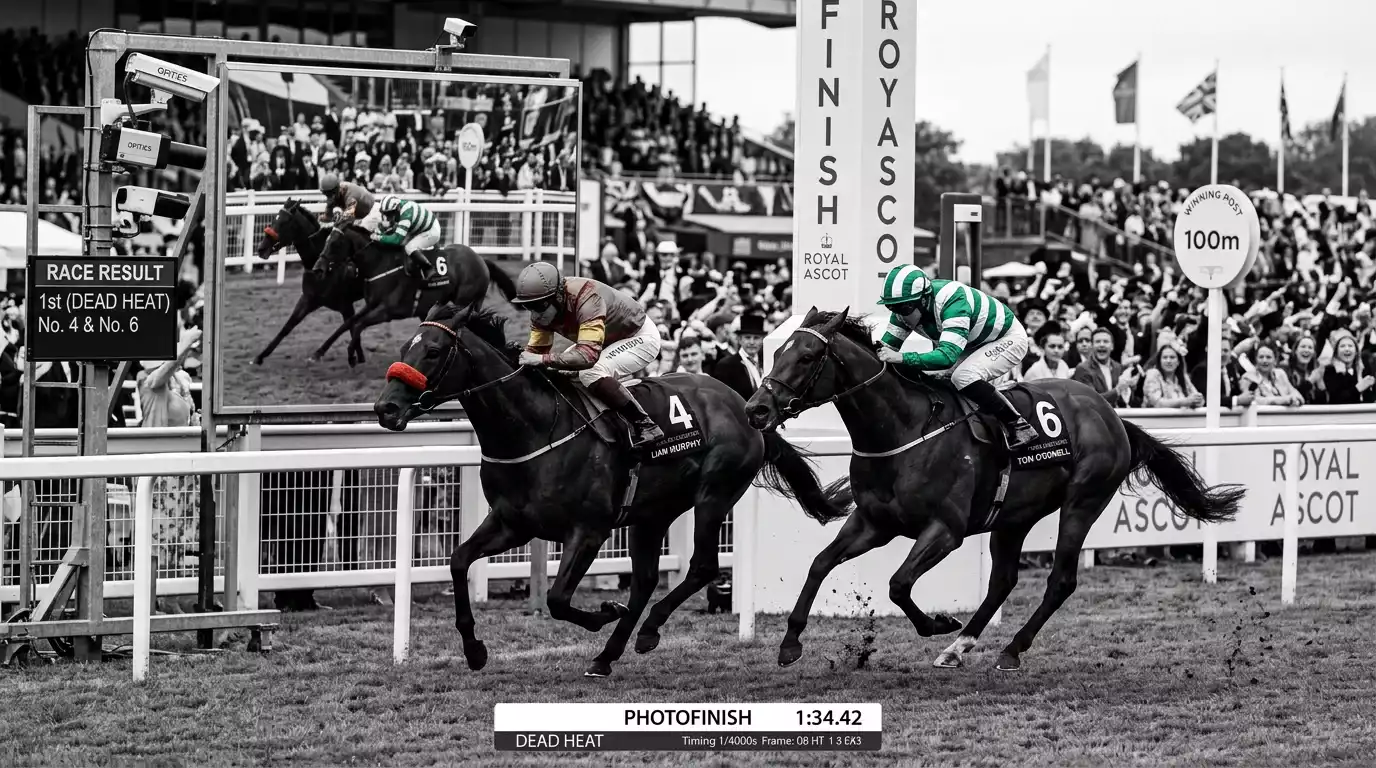
The announcement crackled over the racecourse PA: “Photograph for third place.” I had money on one of the horses, each-way, in a race paying three places. What followed – a declared dead heat – introduced me to one of racing’s most misunderstood betting scenarios. My full place payout became half, and my initial reaction was to feel cheated. Understanding the mathematics changed that perspective entirely.
Dead heats occur when two or more horses finish so close together that the photo-finish camera cannot separate them. In the place market, this creates a situation where more horses technically “place” than the designated number of paying positions. Bookmakers resolve this through a reduction system that divides returns proportionally among the dead-heating horses. The rules are logical once understood, but they catch punters off-guard precisely because dead heats are relatively rare.
The financial impact can be significant. On a 20/1 each-way selection finishing in a dead heat for third, your expected place return drops by half through no fault of your own analysis. Understanding when and how dead heat rules apply helps set realistic expectations and informs stake sizing decisions.
The Dead Heat Rule Explained
Dead heat rules operate on a simple principle: your returns are divided by the number of horses dead-heating for positions that exceed the available places. The calculation applies to your stake, not your odds – you receive full odds on a reduced portion of your stake.
Consider a race paying three places where horses finish in a dead heat for third. Four horses have technically finished in the top three positions – the winner, second, and two horses tied for third. Only three places are paid, but four horses occupy them. Your stake is halved, and you receive full place odds on that half.
The formula: Payout = (Stake ÷ Dead Heat Reduction) × (Odds + 1)
For a £10 place stake at 4/1 place odds in a dead heat between two horses: (£10 ÷ 2) × 5 = £25 return. Without the dead heat, you’d receive £10 × 5 = £50. The dead heat halves your return.
Critically, the dead heat reduction applies only when the tied position affects your bet. If horses dead-heat for first place and you backed one of them each-way, the dead heat reduction applies to both your win and place portions. If horses dead-heat for fifth in a three-place market, your place bet is unaffected – the tie doesn’t involve a paying position.
The reduction factor equals the number of horses dead-heating minus the number of “spare” places available. Two horses dead-heating for third in a three-place race means a reduction of 2 (both tied for the one remaining place). Three horses dead-heating for second in a three-place race also means a reduction of 2 (three horses competing for two remaining places).
Dead Heat Payout Calculations
Let me work through several scenarios that illustrate how dead heat mathematics apply in practice.
Scenario 1: £5 each-way at 12/1, 1/5 place terms, horse dead-heats for third in an eight-runner race (three places paid).
Win portion: Lost entirely (horse didn’t win). -£5.
Place portion without dead heat would be: £5 × (12/5 + 1) = £5 × 3.4 = £17.
Place portion with dead heat (2 horses): £5 ÷ 2 × 3.4 = £8.50.
Net result: £8.50 – £10 total stake = -£1.50 loss.
Without the dead heat, this bet would have returned £7 profit. The dead heat turned a winning position into a small loss.
Scenario 2: £10 each-way at 8/1, 1/4 place terms, horse dead-heats for first in a six-runner race (two places paid).
Win portion with dead heat: £10 ÷ 2 × 9 = £45 (instead of £90).
Place portion with dead heat: £10 ÷ 2 × 3 = £15 (instead of £30).
Total return: £60 from £20 stake = £40 profit.
Even with the dead heat reducing both portions, this remains highly profitable. The dead heat for first affects both win and place, as the winning horse necessarily also places.
Scenario 3: £20 place-only at 3/1 place odds, three horses dead-heat for second in a four-place race.
Available places: 4. Positions occupied by dead heat: 2nd, 3rd, 4th (all three horses technically in places 2-4).
Dead heat reduction: 3 horses for 3 remaining places = no reduction. All three fully place.
This scenario shows that dead heats don’t automatically trigger reductions – they only apply when more horses finish in tied positions than places remain.
Multiple Horse Dead Heats
Dead heats involving three or more horses increase the reduction factor proportionally. These are rare but not unknown, particularly in large-field handicaps where multiple horses can finish in a close cluster.
Three-way dead heat for a single remaining place: your stake is divided by 3. Four-way dead heat: divided by 4. The mathematics extend logically regardless of the number involved.
Example: £6 place stake at 5/1 place odds, three horses dead-heat for third in a three-place race.
One place remains (third), three horses tie for it. Reduction factor: 3.
Payout: £6 ÷ 3 × 6 = £12 (instead of £36 without dead heat).
The impact of multi-way dead heats is severe. Your return drops to one-third in this scenario, potentially turning what seemed like a profitable bet into a loss depending on the odds involved.
Complex scenarios arise when dead heats span multiple positions. If horses dead-heat across second and third in a three-place race, the calculation accounts for how many horses share those specific positions. These situations require careful application of the rules, and bookmaker settlement occasionally generates disputes that warrant checking your slip against their calculations.
FAQ
Accounting for Dead Heat Possibilities
Dead heats are unpredictable – no form analysis or race reading helps anticipate them. They’re essentially random events from a betting perspective, occurring when two horses happen to cross the line simultaneously.
The practical response is awareness rather than avoidance. Know that dead heats reduce your returns, factor that into your understanding of place betting variance, and check settlements carefully when dead heats occur. Bookmaker errors in dead heat calculations, while uncommon, do happen.
For the broader context of place bet calculations including standard scenarios, see our place bet odds calculator guide – understanding normal returns makes dead heat reductions easier to process.
Articles
Published by the placebethorseracinguk.com team.
